
Juggling is one of those skills that looks impossibly difficult from the outside, yet with the right approach, almost anyone can learn it. Whether you want to impress your friends, challenge your brain, or simply pick up a new hobby, learning how to juggle 3 balls is a deeply rewarding experience. The key is not raw talent — it is a systematic, patient approach to building the right muscle memory.
Learning how to juggle 3 balls can be an exciting journey. Mastering this skill opens up new opportunities for entertainment and fun.
As you follow this guide on how to juggle 3 balls, remember to be patient and practice consistently.
This guide is based on the proven teaching method of Chris from Juggling Secrets, and it will walk you through every stage of the process: from choosing the right equipment, to mastering a single ball, to confidently running a continuous 3-ball cascade. Follow each step at your own pace, and you will be juggling sooner than you think.
Understanding how to juggle 3 balls will enhance your coordination and timing.
What Equipment Do You Need to Learn To Juggle 3 Balls?
Start by practicing how to juggle 3 balls with a focus on accuracy and height.
Using the right equipment will help you when learning how to juggle 3 balls effectively.
How to Juggle 3 Balls with Ease
Three matching juggling balls are all you need to get started.
Keep in mind that practice is essential for mastering how to juggle 3 balls.
Before you throw a single ball, it is worth spending a moment on equipment. The single most important rule is this: use three balls that are the same size and the same weight. When all three balls are identical, they travel the same arc, peak at the same height, and drop at the same speed. This consistency is what makes the pattern learnable. Mixing a tennis ball with a basketball, for example, introduces unpredictable variables that will frustrate your progress.
| Equipment Type | Pros | Cons |
|---|---|---|
| Beanbag juggling balls (recommended) | Consistent weight, don’t roll when dropped, soft and easy to grip | Small upfront cost |
| Tennis balls | Widely available, free if you already own them | Bounce and roll away when dropped, can feel light |
| Racquetballs / baseballs | Good weight | Hard surface makes drops chaotic |
| Fruit (oranges, apples) | Great for a first try | Inconsistent size/weight, bruise easily |
Visualizing your throws can greatly assist you in learning how to juggle 3 balls.
Consistent practice will make how to juggle 3 balls feel effortless over time.
Remember, the key to learning how to juggle 3 balls is repetition and focus.
Don’t rush through the steps to learn how to juggle 3 balls; take your time.
As you advance, you’ll find joy in how to juggle 3 balls effortlessly.
Practicing how to juggle 3 balls is a fantastic way to improve hand-eye coordination.
Focus on your timing and rhythm as you learn how to juggle 3 balls.
Using precise movements is vital when mastering how to juggle 3 balls.
Chris from Juggling Secrets recommends the Higgins Brothers 3-ball set, available on Amazon for around $24. These are professional-grade beanbag balls that are weighted just right and, crucially, stay where they land when you drop them — which you will, especially at first. That said, three matching tennis balls are perfectly fine to start with.
The Golden Rule: The Throw Matters More Than the Catch
Before diving into the steps, internalize this principle: in juggling, the throw is more important than the catch. This is counterintuitive. Most beginners focus on frantically grabbing balls out of the air. But if your throw is accurate — if the ball peaks at the same spot every single time — the catch becomes almost automatic. The ball will arc up, reach its peak, and fall directly into your waiting hand.
This is why every step in this guide emphasizes the quality and consistency of your throw above all else. A perfect throw is a ball that peaks just above eye level and lands in a predictable spot. Everything else follows from that.
Remember, the more you practice how to juggle 3 balls, the better you’ll become.
Step 1 — Master the One-Ball Toss
The one-ball exercise: throw the ball in a smooth arc just above eye level, from hand to hand.
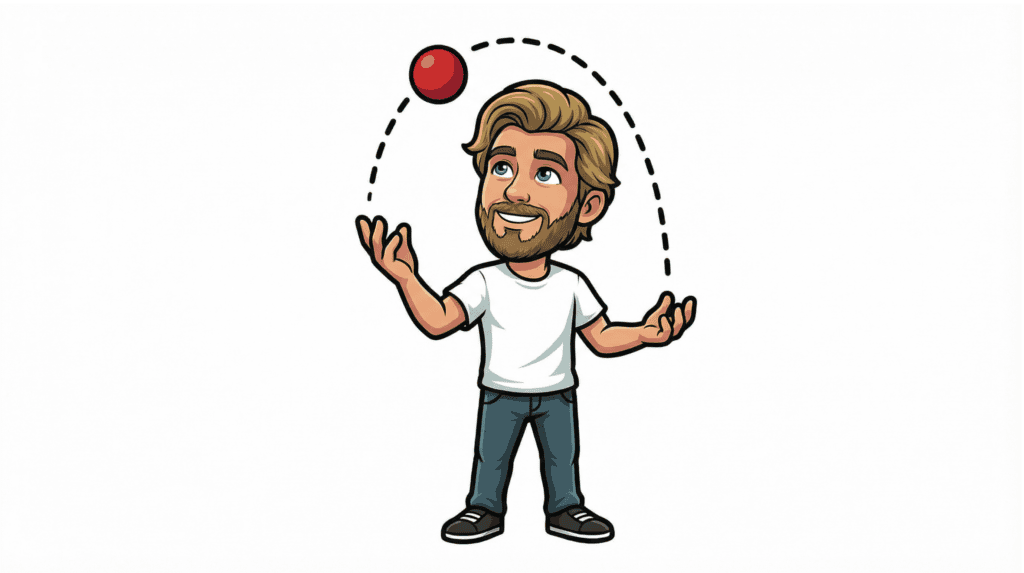
This is the most “boring” step, but it is also the most important. Pick up a single ball and practice throwing it from one hand to the other in a smooth arc. The peak of the arc should sit just above eye level. Do not look at your hands — look at the peak of the arc where the ball will be at its highest point.
What you are training: You are building the muscle memory for a consistent, repeatable throw. The ball should peak at the same height and in the same horizontal position every single time. When a ball reaches a consistent peak, it will always fall back to the same location — right into your hand.
How long should you practice this? Until you can make 20 to 30 consecutive throws without the ball drifting forward, backward, or to the side. If the ball keeps drifting in front of you, you are releasing it too late. If it goes behind you, you are releasing too early.
Pro Tip: Your elbows should stay close to your body, bent at roughly a 90-degree angle. Avoid letting your arms extend outward. Keeping your elbows in creates a compact, efficient pattern and prevents the common “walking juggler” problem where you keep chasing the balls forward.
Step 2 — The Two-Ball Exchange
The two-ball exchange: throw the first ball, and when it peaks, throw the second.
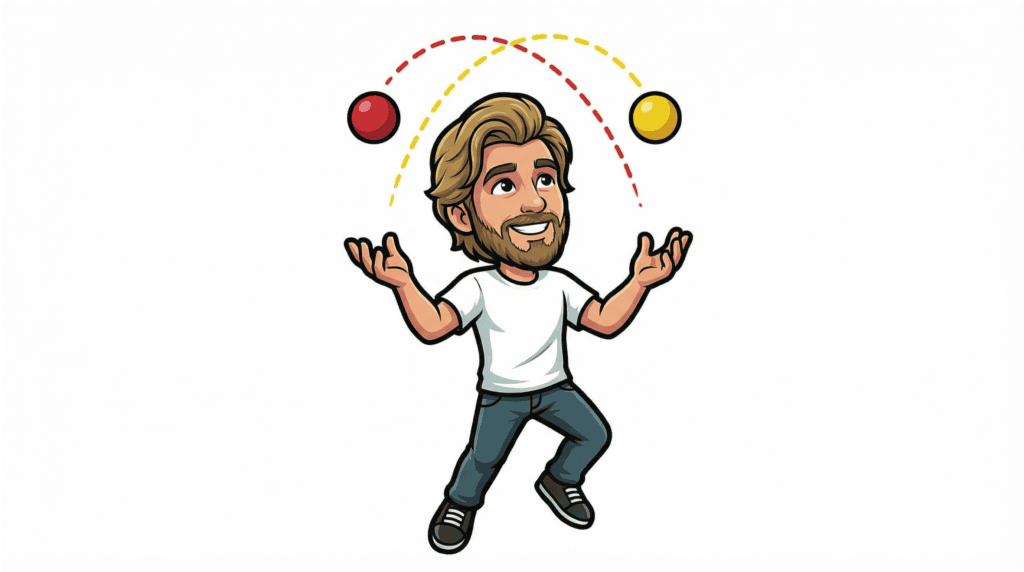
Once you are comfortable with the one-ball toss, pick up a second ball. Hold one ball in each hand. Now, execute the following sequence:
- Throw the first ball from your dominant hand, just as you practiced.
- Watch the first ball rise. When it reaches its peak — that spot just above eye level — throw the second ball from your other hand.
- Catch the first ball in your non-dominant hand, then catch the second ball in your dominant hand.
The critical detail here is timing: the second throw happens at the peak of the first throw, not before and not after. Think of it as “peak, throw” — the moment the first ball peaks, you throw the second.
The mistake to avoid — the “shower” pattern: Many beginners instinctively pass the second ball directly from one hand to the other, or throw both balls simultaneously. This is called the “shower” pattern, and while it is a legitimate juggling style, it is significantly harder to scale to three balls. Both balls must travel through the air in separate arcs. The mantra here is: throw, throw — never hand-off.
Eventually, you’ll find joy in how to juggle 3 balls when practiced regularly.
As you gain confidence, your ability to how to juggle 3 balls will flourish.
Understanding the basics will help you grasp how to juggle 3 balls quickly.
A helpful trick is to say “throw, throw” out loud as you practice. It sounds silly, but verbalizing the action forces your body to follow through. Aim for 50 clean two-ball exchanges before moving on to three balls.
Keep practicing the fundamentals of how to juggle 3 balls to progress.
Focusing on your throws is crucial when learning how to juggle 3 balls.
Step 3 — Juggling Three Balls
The 3-ball cascade: the same arc pattern, now with a third ball entering the sequence.
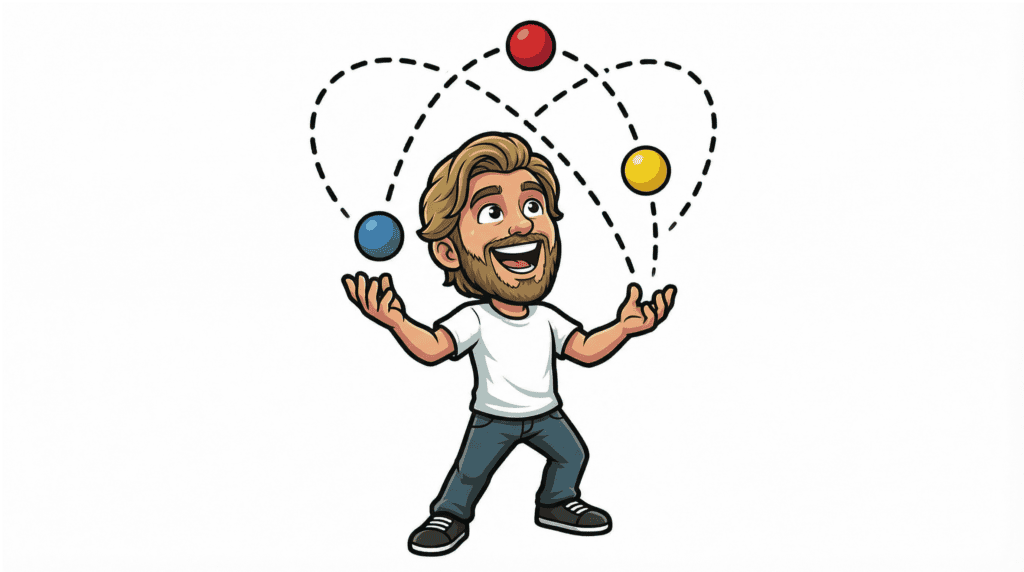
This is the moment everything comes together. The three-ball cascade is simply an extension of what you have already been practicing. The pattern is identical — the only difference is that there is now a third ball entering the sequence.
Starting position: Hold two balls in your dominant hand and one ball in your non-dominant hand. You will always start with the hand that has two balls.
Practice regularly to ensure you master how to juggle 3 balls effectively.
The sequence:
- Throw the first ball from your dominant hand (the same arc as always).
- When the first ball peaks, throw the second ball from your non-dominant hand.
- When the second ball peaks, throw the third ball from your dominant hand.
- Catch, and keep going.
Say “throw, throw, throw” out loud as you go. Your initial goal is simply to complete three throws and three catches without dropping. Once you can do that consistently, extend to four, then five, then ten. After about 15 minutes of focused practice, most beginners can feel the pattern starting to click.
The wall trick: If you find yourself drifting forward and chasing the balls, stand facing a wall with your arms just barely able to reach it. If your throws drift forward, your knuckles will graze the wall — a gentle but effective reminder to keep the pattern close to your body.
Common Mistakes and How to Fix Them
Once you grasp how to juggle 3 balls, it opens up new juggling opportunities.
| Mistake | Why It Happens | Fix |
|---|---|---|
| Walking forward while juggling | Throws are drifting out in front of you | Practice facing a wall; keep elbows at 90° |
| Throwing both balls at the same time | Rushing the second throw | Say “throw, throw” out loud; wait for the peak |
| Inconsistent throw height | Not enough one-ball practice | Go back to Step 1 and drill the single-ball arc |
| Dropping the third ball | Third throw is rushed or off-target | Focus on the first two throws being perfect; the third follows |
| Tensing up as the pattern gets longer | Anxiety and over-thinking | Breathe, relax your shoulders, slow the throws down slightly |
Practice Tips to Progress Faster
Practice in short, focused sessions. A few minutes of concentrated practice each day is far more effective than one long, frustrated session per week. Chris recommends just a few minutes a day for one to two weeks to get the full pattern solid.
Always go back to basics when you struggle. If your three-ball juggling falls apart, do not keep grinding through it. Drop back to two balls, or even one ball, and re-establish the quality of your throws. The foundation is everything.
Stop when you make a mistake, then restart. This is a form of discipline that accelerates learning. Rather than powering through a messy sequence, pause, reset, and begin again cleanly. This trains your brain to associate juggling with clean, correct throws rather than chaotic recovery attempts.
Set incremental targets. Aim for 3 clean throws, then 5, then 10, then 20, then 50. Having a concrete number in mind gives each practice session a clear goal and makes progress visible and motivating.
Use beanbag balls. Beyond the consistency benefits, beanbag balls are forgiving. You can squeeze them when you get frustrated, toss them on the ground without them bouncing away, and handle them comfortably for long practice sessions.
Frequently Asked Questions
How long does it take to learn how to juggle three balls?
Most beginners can complete three clean throws within their first 15–30 minutes of practice. Reaching a continuous juggle of 10+ throws typically takes a few days to a week of short daily practice sessions.
What are the best juggling balls for beginners?
Beanbag-style juggling balls are the top recommendation for beginners. The Higgins Brothers 3-ball set is a popular choice. Avoid balls that bounce or roll, as they make practice sessions frustrating.
What is the 3-ball cascade?
The 3-ball cascade is the fundamental juggling pattern where three balls travel in alternating arcs between two hands. It is the first pattern every juggler learns and the foundation for all more advanced tricks.
Why do I keep walking forward when I juggle?
This is one of the most common beginner problems. It happens because your throws are drifting out in front of you. Practice facing a wall to train yourself to keep throws close to your body.
What comes after the 3-ball cascade?
Once you are comfortable with the cascade, you can explore patterns like the shower (a circular pattern), juggler’s tennis, the half-shower, and eventually 4-ball and 5-ball juggling.
For a visual, real-time demonstration of every step in this guide, watch the original tutorial from Chris at Juggling Secrets: How to Juggle for Beginners (The Easiest Way) — Juggling Secrets on YouTube
Ready to take your juggling further? Subscribe to Juggling Secrets on YouTube for tutorials on the shower pattern, 4-ball juggling, clubs, and much more.
I have a full video course that teaches you everything else you could ever want to know about juggling. Get the course by clicking here.

Recent Posts
Can Juggling Improve Your Brain? The Surprising Benefits of Juggling for the Mind
Juggling is an activity that most of us associate with entertainment and circuses. But did you know that juggling can do wonders for your brain? It's true! Juggling has been found to have numerous...
Stress is a common experience for adults. Juggling For Stress Relief can be a helpful coping strategy for managing stress. Juggling has many benefits including reducing stress, improving mental...